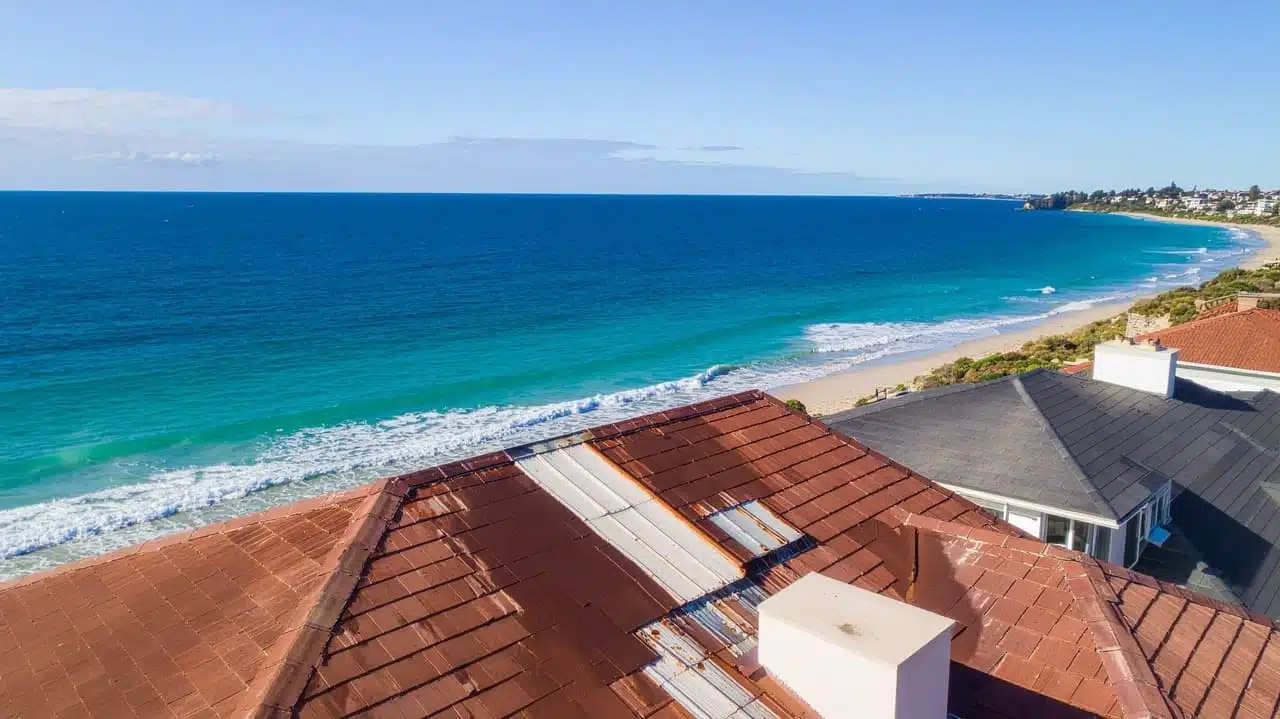
Metal roofs within three kilometres of Perth’s coastline face relentless attack from salt-laden air. This accelerates corrosion at rates up to five times faster than inland properties. Homes in Fremantle, Cottesloe, and Scarborough experience this accelerated degradation daily as salt particles deposit continuously onto roof surfaces.
The coastal suburbs stretching from Fremantle through Cottesloe to Scarborough represent some of Perth’s most desirable postcodes. Their proximity to the Indian Ocean creates specific challenges for roof longevity that demand understanding and proactive protection strategies.
Properties that neglect coastal roof corrosion face premature roof failure, costly emergency repairs, and diminished property values. Understanding how marine environments interact with roofing materials enables homeowners to implement protection strategies that extend roof life despite harsh conditions.
How Salt Air Attacks Coastal Roofs
Salt particles carried by ocean breezes settle onto roof surfaces and attract moisture from the air. This creates a corrosive electrolyte solution even during dry periods. This hygroscopic quality means coastal roofs remain damp longer than inland properties, as salt crystals continuously draw atmospheric moisture to metal surfaces.
The resulting electrochemical reaction breaks down protective zinc coatings on Colorbond and galvanised iron roofs. Wind direction and intensity determine salt deposition rates across different properties. Westerly and south-westerly winds drive the highest concentrations of airborne salt particles toward roofing systems.
Fremantle properties facing the ocean receive heavier salt loads than those sheltered by neighbouring buildings. Elevated homes in Cottesloe and Scarborough experience increased exposure due to unobstructed wind paths. These variations create different corrosion timelines even within the same suburb.
Morning dew cycles compound the problem by providing daily moisture that activates deposited salt repeatedly. Unlike inland properties where dew evaporates quickly, coastal roofs maintain higher humidity levels throughout the day. This extends the active corrosion period and explains why coastal roofs deteriorate faster than identical materials installed just five kilometres inland.
Early Warning Signs of Corrosion Damage
Surface rust appearing as small brown spots represents the initial stage of corrosion breakthrough where protective coatings have thinned or failed. These spots often appear first on roof ridges, valleys, and northern-facing slopes where UV exposure and heat accelerate coating degradation.
Homeowners who address corrosion at this stage prevent exponential damage progression. Once bare metal becomes exposed, deterioration accelerates rapidly. White powdery deposits accumulating on roof surfaces indicate zinc carbonate formation as the galvanising layer reacts with salt and moisture.
While some zinc sacrifice protects the underlying steel, extensive white deposits signal rapid protective layer depletion. Properties in Scarborough’s beachfront areas commonly show this condition within 10-12 years of installation compared to 15-20 years for inland roofs.
Paint blistering and flaking reveal coating adhesion failure caused by salt penetration beneath the paint film. Once salt reaches the metal-paint interface, it creates osmotic pressure that lifts the coating away from the substrate. The process accelerates in areas where roof cleaning has been neglected, allowing salt accumulation to reach critical concentrations.
Fastener corrosion manifests as rust stains radiating from screw and nail locations where penetrations through the roof create vulnerable points for moisture entry. Coastal environments attack these fasteners aggressively, with corrosion products expanding and cracking surrounding paint. Inspections across Cottesloe properties consistently identify fastener corrosion as a primary leak pathway requiring attention.
Material Performance in Marine Environments
Colorbond steel with Zincalume coating demonstrates superior salt air corrosion resistance compared to traditional galvanised iron. The aluminium-zinc alloy provides enhanced protection in marine exposures as the aluminium component forms a stable oxide layer that resists salt attack more effectively than pure zinc.
Properties that upgraded from galvanised to Colorbond during roof replacement report significantly reduced corrosion rates in coastal conditions. Terracotta and concrete tiles avoid metallic corrosion entirely, though coastal exposure creates different challenges including salt efflorescence, surface erosion, and fastener deterioration.
The tiles themselves resist salt damage effectively, but metal valleys, flashings, and ridge caps still require protection. This mixed-material reality means even tile roofs need comprehensive salt air corrosion strategies for metal components.
Coating thickness determines protection duration significantly. Factory-applied Colorbond paint measures 15-35 microns compared to quality restoration coatings at 150-200 microns total thickness. This substantial difference explains why professionally restored roofs often outlast factory finishes in coastal environments. The three-coat Dulux Acratex system creates a barrier substantially thicker than original factory coatings.
Geographic Corrosion Patterns Across Suburbs
Fremantle’s Port-Facing Properties
Fremantle’s port-facing properties experience the most aggressive corrosion conditions in Perth’s metropolitan area as industrial emissions combine with salt spray. Properties within 500 metres of the harbour show corrosion rates approximately 30% higher than those on Fremantle’s eastern boundary.
The historic character homes throughout Fremantle often feature older galvanised iron roofs requiring specialised approaches that preserve heritage aesthetics while providing modern protection. Permacoat, WA’s longest-serving roof restoration company with 50+ years of experience, has developed specific methodologies for protecting these heritage roofs in marine environments using Dulux Acratex accredited coating systems.
Cottesloe’s Beachfront Strip
Cottesloe’s beachfront strip from North Cottesloe to Swanbourne faces direct ocean exposure with minimal windbreaks, creating maximum salt deposition conditions. Properties along Marine Parade and adjacent streets require more frequent maintenance intervals than homes just three blocks inland.
The suburb’s premium property values justify investment in superior protective coatings that extend maintenance cycles and preserve appearance. Properties implementing proactive coastal roof corrosion defence strategies maintain values and avoid the negotiation leverage that visible deterioration creates during property transactions.
Scarborough Properties
Scarborough properties from Scarborough Beach Road to the coastline experience similar exposure levels to Cottesloe with the added factor of increased building height creating greater wind speeds at roof level. Apartment buildings and multi-storey homes face accelerated corrosion on upper levels where salt-laden winds strike with full force.
Beachfront developments require coordinated maintenance programs that address this heightened exposure through systematic cleaning schedules and regular professional inspections.
Protective Coating Systems for Salt Environments
Dulux Acratex membrane coatings formulated specifically for coastal applications incorporate corrosion inhibitors and enhanced UV stabilisers that address marine environment challenges effectively. The primer sealer coat penetrates existing surface corrosion, converting rust and creating a stable foundation that prevents further oxidation.
The conversion process proves critical for coastal roofs where complete corrosion removal would compromise roof integrity through excessive material removal. Two-coat topcoat application builds film thickness to levels that resist salt penetration while maintaining flexibility for thermal expansion requirements.
Coastal temperature fluctuations combined with salt exposure create demanding conditions that rigid coatings cannot withstand long-term. The elastomeric properties of premium roof coatings allow movement without cracking, maintaining barrier integrity through seasonal cycles.
Colour selection influences coating performance in coastal environments significantly. Lighter colours reflect solar radiation and reduce surface temperatures that accelerate coating degradation. Lighter roofs in Fremantle, Cottesloe, and Scarborough maintain coating integrity approximately 20% longer than dark colours under identical exposure conditions.
Maintenance Intervals for Coastal Properties
Annual high-pressure roof cleaning removes accumulated salt deposits before they reach concentrations that overwhelm protective coatings. Properties that implement this preventive schedule extend coating life by 40-60% compared to those cleaned only when visible contamination appears.
The investment in regular cleaning proves substantially more economical than premature recoating caused by salt accumulation damage. Biannual inspections identify emerging corrosion before it progresses to structural compromise, allowing targeted repairs that prevent extensive damage.
Coastal roof inspections should specifically examine valleys, penetrations, and fasteners where corrosion initiates most frequently. Inspection protocols for coastal properties include detailed documentation of corrosion progression, enabling homeowners to make informed decisions about repair timing and scope.
Five to seven-year recoating intervals maintain optimal protection for coastal roofs compared to ten to twelve-year cycles for inland properties. This accelerated schedule reflects the reality of marine environment exposure and prevents the complete coating failure that necessitates more expensive restoration. Properties that adhere to these intervals maintain superior appearance and avoid emergency repair situations when corrosion reaches advanced stages.
Valley and Flashing Protection Strategies
Metal valleys concentrate water flow and debris accumulation, creating conditions where salt solutions remain in contact with metal surfaces for extended periods. These areas require additional coating thickness and more frequent inspection than general roof surfaces as valley corrosion often progresses unnoticed until leaks develop requiring professional roof repairs.
Flashing around chimneys, vents, and roof penetrations creates joints where coating application proves challenging and salt penetration finds easy pathways. Proper flashing preparation during professional roof painting includes removal of existing corrosion and application of corrosion-converting primers with careful detailing ensuring complete coating coverage.
These labour-intensive steps distinguish professional coastal roof corrosion protection from basic paint applications. Ridge capping experiences maximum UV exposure combined with salt deposition, creating the harshest conditions on any roof surface. Coastal properties frequently require ridge cap replacement or extensive repair during restoration, with corrosion often advanced beyond coating repair capability.
Cost Implications of Coastal Location
Restoration pricing for coastal properties typically exceeds inland equivalents by 15-25%, reflecting additional surface preparation requirements, specialised coating systems, and increased material consumption. The premium acknowledges the reality of working with surfaces showing existing corrosion and the need for enhanced protection systems.
Properties that delay restoration face exponentially higher costs as corrosion progresses from surface coating to structural metal requiring replacement. Insurance considerations for coastal properties include higher premiums and specific coverage limitations related to corrosion damage.
Maintaining documented maintenance records and professional restoration history can influence coverage decisions and claim outcomes. The comprehensive warranties provided demonstrate professional workmanship standards that insurance providers value when assessing risk.
Property value protection justifies premium restoration investment in Fremantle, Cottesloe, and Scarborough’s competitive real estate markets. A well-maintained roof with documented coastal protection measures adds tangible value during property transactions, while visible corrosion damage creates significant negotiating leverage for buyers.
Storm Damage and Corrosion Interaction
Winter storms deliver concentrated salt spray that penetrates further inland than normal conditions, with a single severe weather event depositing salt loads equivalent to months of normal exposure. Properties that weather these events with compromised coating protection experience accelerated corrosion in the following months as deposited salt continues its destructive work.
Post-storm roof cleaning within two weeks of major weather events removes these concentrated deposits before salt creates permanent coating degradation. Wind-driven rain forces salt solutions into joints, overlaps, and fastener penetrations that remain dry during normal conditions.
This intrusion creates corrosion in locations typically protected from direct exposure and explains why coastal roofs develop seemingly random corrosion patterns across different roof sections. Professional restoration addresses these vulnerable areas with specific detailing that prevents moisture and salt intrusion.
Hail damage that would represent minor cosmetic issues on inland roofs becomes a serious corrosion risk in coastal environments by breaking protective coatings and exposing bare metal. Even small coating breaches provide entry points for salt penetration that rapidly expands damage through undercutting.
The Dulux Acratex Advantage in Marine Environments
Dulux Acratex’s formulation development includes specific testing in marine exposure conditions through decades of Australian coastal application. This provides confidence that specified systems will perform as predicted in Fremantle, Cottesloe, and Scarborough’s demanding conditions, while generic roof paints lack this validation and frequently fail prematurely in salt air environments.
The 15-20 year coating warranty reflects Dulux Acratex’s proven durability and the application standards that ensure performance. This warranty coverage provides homeowners with protection against premature coating failure and transfers risk from the property owner to the restoration company and coating manufacturer.
Few coating systems offer comparable warranty terms for coastal applications. Colour stability in marine environments distinguishes Dulux Acratex from alternative products through UV stabilisers and pigment selection specifically addressing harsh Australian coastal sun exposure. Roofs restored with these systems maintain appearance substantially longer than those coated with products developed for less demanding environments.
Professional Assessment and Restoration Planning
Comprehensive roof inspections for coastal properties should include moisture meter readings, coating thickness measurements, and detailed corrosion mapping that establishes baseline conditions. This data-driven approach enables accurate restoration scope definition and realistic timeline predictions with documentation supporting informed decision-making.
Inspection methodology documents existing conditions photographically and provides written reports that prove invaluable for capital planning, insurance purposes, and due diligence during property transactions. Restoration timing considerations for coastal roofs favour proactive intervention before corrosion reaches advanced stages requiring extensive metal replacement.
The economic analysis consistently demonstrates that earlier restoration proves more cost-effective than delayed response, as restoration costs increase exponentially once damage progresses from surface coating issues to structural metal deterioration. Properties approaching 10-12 years since last coating in coastal locations should schedule professional assessment regardless of visible condition.
Multi-property planning for investors and strata managers benefits from coordinated scheduling that achieves economies of scale while addressing properties before emergency situations develop. Experience with strata roofing services enables efficient project management across multiple buildings, minimising disruption while maximising cost efficiency. This coordinated approach proves particularly valuable for coastal apartment complexes where access logistics and resident impact require careful management.
Conclusion
Salt air corrosion represents a non-negotiable challenge for roof longevity in Fremantle, Cottesloe, and Scarborough’s coastal environments. The combination of continuous salt deposition, elevated moisture levels, and intense UV exposure creates conditions that demand superior protective systems and proactive maintenance strategies.
Properties that implement appropriate protection measures and maintenance schedules achieve roof service lives comparable to inland locations. For expert protective roof coatings backed by 50+ years of coastal experience and Dulux Acratex accredited systems, call (08) 9249 5955 to book your free inspection.