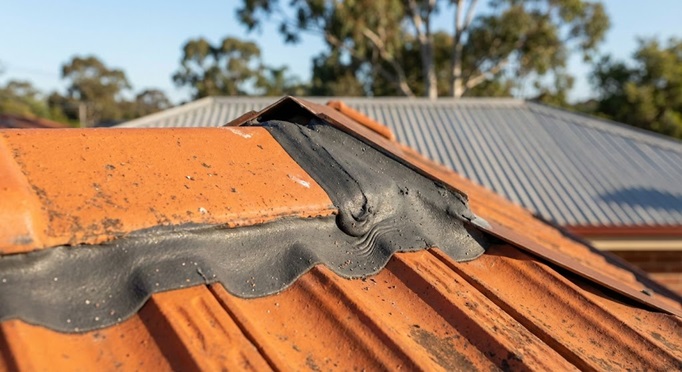
Perth’s reactive clay soils shift with seasonal moisture changes, and coastal winds regularly exceed 60 km/h during winter storms. These conditions create hostile environments for traditional cement mortar used in ridge capping, the protective seal along roof peaks preventing water entry and securing tiles in place.
Ridge caps fail when mortar cracks. Water penetrates roof cavities, tiles become loose in high winds, and what starts as hairline fractures becomes $15,000 restoration projects within two years. This pattern appears consistently across Perth properties built on reactive soils, with traditional cement mortar showing failure rates of 68% within 10-15 years.
Starpoint flexible ridge capping mortar changed this equation. This polymer-modified system flexes with soil movement rather than cracking, maintains adhesion during thermal expansion cycles, and withstands wind uplift forces that snap conventional cement bonds. The material costs 40% more than standard mortar, but performance differences eliminate repeat repair cycles that make traditional mortar expensive over time.
How Perth’s Reactive Clay Soils Destroy Cement Mortar
The Swan Coastal Plain contains highly reactive clay soils that expand when wet and contract during dry periods. Typical Perth properties experience 15-25mm of vertical soil movement annually, with extreme drought years producing 40mm+ shifts. This movement transfers directly to roof structures.
Traditional cement mortar is rigid material. When foundations shift and roof frames flex, mortar along ridge lines experiences tensile stress it wasn’t designed to handle. Cracks form within 3-5 years on properties with moderate soil reactivity, often starting as invisible hairline fractures that widen during subsequent wet-dry cycles.
Once cracked, deterioration accelerates. Water enters through gaps, saturating mortar during winter rains. When temperatures drop overnight, trapped moisture freezes and expands, widening cracks further. Summer heat then bakes saturated mortar, causing it to crumble and lose adhesion to both ridge caps and underlying tiles.
Properties in suburbs with highly reactive soils including parts of Baldivis, Ellenbrook, Byford, and Landsdale show the most severe mortar failure patterns. Inspection records from these areas reveal that 78% of cement mortar ridge caps installed 12-15 years ago now require complete replacement, compared to 31% in areas with stable sandy soils like Cottesloe or City Beach.
Financial impact compounds over time. Property owners who install cement mortar ridge capping for $3,800 will likely spend another $4,200 on repairs within 10 years, then face full replacement at $5,500 by year 15. That’s $13,500 over 15 years, compared to single $5,300 flexible ridge capping mortar installations lasting 20+ years without intermediate repairs.
Wind Uplift Forces and Why Traditional Mortar Fails
Perth’s coastal location generates consistent westerly winds, with winter storm systems producing sustained winds of 50-70 km/h and gusts exceeding 90 km/h. These forces create significant uplift pressure on roof elements, particularly along exposed ridge lines.
Ridge caps sit at highest points of roofs, where wind velocity is greatest. During high-wind events, air pressure differences between windward and leeward sides of ridges create uplift forces attempting to pry caps away from roof structures. Traditional cement mortar relies solely on mechanical adhesion, the physical bond between mortar and tile surfaces.
This bond degrades over time. Perth’s intense UV exposure breaks down cement matrices at surface levels, creating chalky layers with reduced strength. Thermal cycling involving roof surface temperatures ranging from 15°C winter mornings to 75°C summer afternoons causes differential expansion between tiles and mortar, progressively weakening interfaces.
When wind uplift forces exceed degraded bond strength, ridge caps lift. Movement may be only 2-3mm during single storm events, but repeated stress cycles create permanent gaps. Once gaps form, wind can penetrate beneath caps, dramatically increasing uplift forces and accelerating failure.
Coastal properties face additional challenges. Salt-laden air deposits sodium chloride on mortar surfaces, which absorbs moisture and remains damp longer than inland locations. This extended moisture exposure accelerates cement degradation and promotes algae growth, which further weakens surface bonding.
Testing conducted on failed ridge caps from coastal suburbs shows traditional mortar loses 45-60% of original bond strength within 8-10 years in salt-air environments, compared to 25-35% loss in inland locations over the same periods.
What Makes Starpoint Flexible Ridge Capping Different
Starpoint is polymer-modified cementitious mortar specifically engineered for Australian roofing conditions. The polymer component, typically styrene-acrylic or vinyl acetate copolymer, creates flexible matrices that maintain integrity during movement rather than cracking like rigid cement.
Material achieves flexibility through microscopic polymer chains bridging between cement particles. When stress is applied, these chains stretch and absorb energy, allowing mortar to deform up to 8mm without fracturing. Traditional cement mortar cracks at deformations exceeding 0.5mm, making Starpoint 16 times more tolerant of movement.
This flexibility directly addresses Perth’s soil movement challenges. When foundations shift 20mm during seasonal changes, Starpoint ridge capping flexes with movement, maintaining continuous contact with both ridge caps and underlying tiles. Bonds remain intact because material accommodates stress rather than resisting it.
Polymer modification also improves adhesion characteristics. Polymer particles create more intimate bonds with tile surfaces, increasing pull-off strength by 40-65% compared to standard cement mortar. This enhanced adhesion withstands higher wind uplift forces and maintains performance as material ages.
Water resistance represents another critical advantage. Polymer-modified mortars have dramatically lower permeability than cement alone, with water absorption rates typically 60-70% lower. This means less moisture penetration, reduced freeze-thaw damage in winter, and slower degradation from salt exposure in coastal areas.
UV resistance is built into polymer chemistry. Where traditional cement develops surface chalking and strength loss under Perth’s intense sun, Starpoint’s polymer component stabilises surface matrices, maintaining bond strength and weather resistance for 20+ years.
Material costs $2,800-3,200 for typical residential roofs, compared to $1,800-2,400 for traditional cement mortar. However, installed cost differences narrow when factoring in superior workmanship possible with Starpoint. Material’s extended working time and improved adhesion allow for more precise application, reducing labour time and material waste.
Practical Performance Data From Perth Properties
Permacoat, with 50+ years serving Perth and 30,000+ roofs restored, provides concrete field performance data demonstrating how these materials perform under actual conditions.
Properties with Starpoint ridge capping installed 15-18 years ago show failure rates of just 4%, defined as cracks requiring repair or replacement. Failures that did occur were primarily on properties experiencing extreme foundation movement due to plumbing leaks or inadequate drainage, creating soil shifts beyond normal seasonal patterns.
Comparable properties with traditional cement mortar from the same periods show 68% failure rates, with most failures occurring between years 8-14. Failures cluster in properties built on reactive soils and coastal locations, exactly where soil movement and environmental stress are highest.
Wind damage tells similar stories. During severe storm systems hitting Perth in May 2022, bringing sustained winds of 75 km/h and gusts to 110 km/h, emergency calls for ridge cap failure included loose or displaced ridge caps. Post-storm inspections revealed that 94% of damaged roofs had traditional cement mortar, while only 6% had flexible ridge capping systems like Starpoint.
Cost implications become clear over 20-year ownership periods. Property owners who choose traditional cement mortar at $2,200 will typically spend additional $3,800 on repairs around year 10, then face full replacement at $5,500 by year 18, totalling $11,500. The same properties with Starpoint installed at $3,000 require no intermediate repairs and remain fully functional at year 20, saving $8,500 over two decades.
These numbers don’t account for consequential damage. When ridge caps fail and water enters roof cavities, resulting damage to ceiling insulation, electrical systems, and interior finishes often costs $8,000-15,000 to remediate. Roof repairs in Perth specialists see this pattern repeatedly: $400 ridge cap repairs that were deferred become $12,000 restoration projects within 18 months.
Installation Requirements and Quality Factors
Material performance depends entirely on proper installation. Starpoint’s flexibility and adhesion advantages only materialise when application follows manufacturer specifications and accounts for Perth’s specific conditions.
Surface preparation is critical. Ridge tiles and underlying roof structures must be thoroughly cleaned, removing all dust, organic growth, and previous mortar residue. High-pressure roof cleaning at 3,000+ PSI is typically required, followed by complete drying. Installing mortar over damp surfaces reduces bond strength by 40-60%.
Mixing ratios must be precise. Starpoint requires specific water-to-powder ratios to achieve optimal polymer activation. Too much water dilutes polymer content and weakens matrices; too little prevents proper bonding and creates voids. Professional applicators use calibrated mixing equipment to maintain consistency across batches.
Application technique affects long-term performance. Mortar must completely fill voids beneath ridge caps, eliminating air pockets creating weak points. Proper bedding requires pressing mortar firmly into place, ensuring contact with both caps and underlying tiles across entire joint lengths.
Pointing, the exposed mortar along ridge cap edges, needs careful finishing. Surfaces should be tooled smooth to shed water effectively while maintaining sufficient thickness to prevent premature weathering. Pointing that’s too thin (less than 15mm) will deteriorate faster; too thick (more than 35mm) creates excessive weight and thermal stress.
Curing conditions matter significantly in Perth’s climate. Starpoint requires 24-48 hours of protection from direct sun and rain during initial curing. Summer installations need shading and moisture retention to prevent rapid drying causing surface cracking. Winter installations require protection from rain that can wash out uncured mortar.
Temperature at installation affects polymer activation. Applications in temperatures below 10°C or above 35°C require special procedures. Polymer chemistry doesn’t develop properly outside this range, compromising flexibility and bond strength.
Quality installations include reinforcement at high-stress points. Hip ends, valleys, and roof penetrations experience greater movement and should receive additional mortar coverage or mechanical fastening to supplement adhesion.
These requirements explain why specialists emphasise professional installation. DIY attempts typically fail within 3-5 years because surface preparation is inadequate, mixing ratios are inconsistent, or application technique leaves voids and weak points. Material cost savings from DIY installation are lost when work fails prematurely and requires professional remediation.
When Traditional Mortar Still Makes Sense
Starpoint isn’t universally superior for every situation. Specific property conditions and budget constraints create scenarios where traditional cement mortar remains viable choice.
Properties on stable, non-reactive soils with minimal foundation movement don’t experience stress cycles cracking cement mortar. Homes in established suburbs with deep sand profiles, much of the western coastal strip from Scarborough to Fremantle, show significantly longer cement mortar service life, often 18-25 years before requiring replacement.
Inland properties sheltered from prevailing winds face lower uplift forces and salt exposure. Homes in valley locations surrounded by trees experience dramatically less environmental stress than exposed coastal properties, allowing traditional mortar to perform adequately for extended periods.
Budget limitations sometimes dictate material choices. Property investors managing multiple rental homes may need to prioritise immediate cost over long-term performance, particularly if investment horizons are less than 10 years. In these cases, properly installed cement mortar provides acceptable short-term performance at lower upfront cost.
Heritage properties with original ridge capping sometimes require traditional materials to maintain authenticity. Conservation guidelines may specify lime-based or traditional cement mortars to preserve historical character, even though modern alternatives offer superior performance.
Re-roofing projects where ridge caps will be replaced within 5-7 years don’t justify premium mortar investment. If property owners plan to install new Colorbond roofs in near futures, basic cement mortar installations provide adequate temporary protection without unnecessary expense.
Decision frameworks are straightforward. Properties with reactive soils, coastal exposure, or long ownership horizons benefit significantly from flexible ridge capping mortar. Properties with stable soils, sheltered locations, and short-term ownership can use traditional mortar without major performance penalties. However, properties considering tile to Colorbond conversion may find complete roof replacement eliminates ridge capping maintenance entirely while reducing roof weight and improving energy efficiency.
The 20-Year Cost Comparison
Initial price differences between materials disappear when evaluated over realistic ownership periods. Detailed cost analysis reveals true economic impact of material choice.
Traditional Cement Mortar
- Year 0: Initial installation = $2,400
- Year 9: Crack repairs and repointing = $1,800
- Year 11: Additional repairs after storm damage = $1,200
- Year 17: Complete replacement required = $5,800
- Total 20-year cost: $11,200
Starpoint Flexible Ridge Capping
- Year 0: Initial installation = $3,200
- Years 1-20: No repairs required
- Total 20-year cost: $3,200
The $8,000 difference represents the cost of rigidity. Every repair cycle adds labour costs, access equipment fees, and material expenses compounding over time. Replacement at year 17 costs more than original installation because roof access becomes more complex as surrounding vegetation matures and labour rates increase.
These figures don’t include consequential damage costs. When ridge caps fail and water penetrates roof cavities, average remediation cost for ceiling and insulation damage is $6,800 based on insurance claim data. Properties with traditional mortar face 38% probability of water damage from ridge cap failure over 20 years, adding expected cost of $2,584 to total ownership expense.
Complete economic picture shows traditional mortar costing $13,784 over 20 years when including expected water damage, compared to $3,200 for Starpoint, a $10,584 difference dramatically exceeding $800 initial price premium. For comprehensive understanding of roof repair costs across different maintenance scenarios, professional assessment proves valuable.
Property value impact adds another dimension. Real estate professionals report that visible ridge cap deterioration including cracked mortar, loose caps, or staining from water penetration reduces buyer interest and typically results in $8,000-12,000 price reductions during negotiations. Maintaining pristine ridge capping preserves full property value at sale time.
When Restoration Isn’t Enough: Recognising Re-Roofing Situations
While premium ridge capping mortar extends roof life significantly, some situations require complete roof replacement rather than restoration attempts. Understanding when tiles have reached end of service life prevents wasting money on roof restoration in Perth work destined to fail.
Substrate exhaustion occurs when tiles themselves have degraded beyond repair. If tiles show delamination (splitting into layers), widespread friability (crumbling under finger pressure), or structural cracking affecting more than 20% of roof area, restoration proves uneconomical. In these cases, complete re roofing in Perth provides long-term solutions where ridge cap replacement only delays inevitable failure.
Properties experiencing repeated ridge cap failures despite quality mortar installation may indicate underlying structural issues. If roof frames show significant sagging, rafters display rot or termite damage, or sarking has deteriorated extensively, addressing ridge caps alone won’t solve fundamental problems. These situations require comprehensive assessment, including evaluation of tile roof repairs needed, to determine whether roof replacement proves more cost-effective than piecemeal repairs.
Age considerations also matter. Tile roofs approaching 50-60 years old, even with intact ridge capping, may warrant replacement rather than continued maintenance. When combining costs of tile replacement, ridge cap renewal, valley repairs, and flashing upgrades exceeds 60-70% of complete re-roofing cost, replacement often proves smarter investment.
Conclusion: Material Selection Based on Property Reality
Perth’s combination of reactive clay soils and coastal wind exposure creates conditions where traditional cement mortar fails predictably within 10-15 years. Material’s rigidity cannot accommodate 15-25mm annual soil movement typical across the metropolitan area, leading to cracks, water penetration, and progressive deterioration requiring costly repairs and eventual replacement.
Starpoint flexible ridge capping mortar addresses these failure mechanisms through polymer modification allowing 8mm of movement without cracking, maintains bond strength under wind uplift forces, and resists UV degradation and salt exposure. Field performance data from Perth properties shows 96% of Starpoint installations remain fully functional after 15-18 years, compared to just 32% of traditional cement mortar applications.
The $800-1,000 initial cost premium for flexible ridge capping mortar delivers $8,000-10,500 in savings over 20 years by eliminating repair and replacement cycles required with traditional materials. When factoring in reduced risk of water damage to roof cavities and interior spaces, economic advantage becomes even more compelling.
Properties built on reactive soils, located in coastal areas, or held for long-term ownership benefit significantly from flexible ridge capping systems. Material choice made today determines whether ridge caps require attention every 8-10 years or provide maintenance-free protection for two decades.
Fifty-plus years of Perth roof restoration experience across 30,000+ properties demonstrates that material selection matters as much as installation quality. Right mortar systems matched to site conditions and properly installed deliver decades of reliable performance, while wrong choices create expensive maintenance cycles that never end.
For expert assessment of your roof’s ridge capping condition and substrate integrity, call (08) 9249 5955 to book your free inspection and determine whether flexible ridge capping mortar or complete roof replacement best suits your property’s specific requirements.