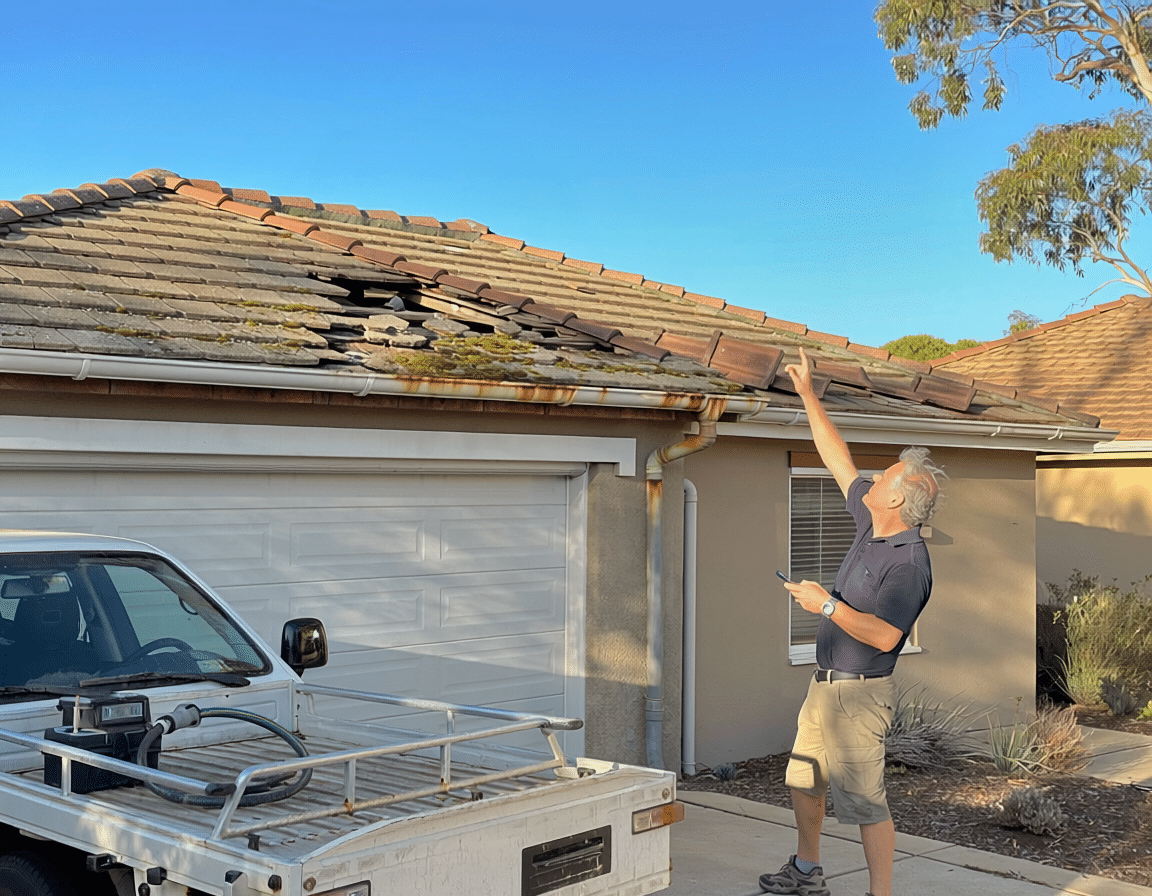
Most Perth homeowners don’t climb onto their roofs – and they shouldn’t need to. The most critical warning signs of roof deterioration are visible from ground level, yet thousands of properties develop serious damage because owners miss these early indicators.
Perth’s climate is uniquely demanding on residential roofing systems. Intense UV radiation during long, dry summers degrades protective coatings from above, while June to August delivers the heavy rainfall that exploits every gap left by that summer damage. This cycle of thermal stress followed by water exposure creates predictable patterns of deterioration – patterns that are readable from the footpath if you know what to look for.
Understanding these ground-level warning signs can save Perth homeowners thousands in emergency repairs and protects property values that typically drop 5-10% when visible roof problems become obvious to buyers or neighbours.
Visible Coating Deterioration and Colour Fading
The protective coating on Perth roofs faces relentless assault from UV radiation that is approximately 30% more intense than European climates. When this coating breaks down, the evidence appears clearly from street level well before any leaks develop inside the home.
Chalking and Powder Indicators
Run a finger along a lower roof edge or downpipe outlet. If white or coloured powder transfers, the coating has degraded past its protective capacity. This chalking indicates the binder has broken down, leaving pigment particles exposed without UV protection.
Once this stage begins, deterioration accelerates rapidly. The underlying tile or metal loses its primary defence precisely when Perth’s summer heat is most intense. Protective roof coatings applied through proper restoration processes provide 15-20 year protection – but only when substrate preparation and application meet Dulux Acratex standards.
Colour Fading Patterns
Roofs don’t fade uniformly across Perth properties. North-facing sections bleach faster than southern aspects, creating a patchwork appearance visible from the street. Coastal properties from Scarborough to Mandurah show accelerated fading on ocean-facing sections – salt-laden winds strip protective coatings approximately 40% faster than inland suburbs.
This uneven fading is an important diagnostic tool. When the colour variation between roof planes becomes noticeable from ground level, the coating is already in an advanced stage of UV-driven deterioration.
Visible Substrate Through Worn Coating
When terracotta orange or concrete grey shows through what should be a solid colour coating, the protective layer has worn to dangerous thinness. This typically appears first along ridges and edges, where wind-driven rain concentrates weathering forces.
Properties showing substrate exposure need attention before water penetration begins. Coating deterioration follows an exponential curve rather than a linear decline – the rate of damage increases significantly once the substrate becomes exposed.
Biological Growth Patterns That Signal Moisture Issues
Moss, lichen, and algae don’t appear randomly. They indicate specific moisture and drainage problems that compromise roof integrity over time, and their location often reveals exactly what type of problem is developing.
Growth Location Diagnostics
Perth’s winter rain patterns encourage biological growth on southern and western roof aspects that receive less direct sunlight for natural drying. Dark green or black patches visible from ground level indicate established colonies that retain moisture against the roof surface for extended periods.
This sustained dampness accelerates coating breakdown in those areas and creates conditions for tile surface deterioration. Properties in tree-lined suburbs from Nedlands to Kalamunda face accelerated biological growth due to organic debris accumulation and reduced direct sunlight throughout the day.
Drainage Problem Indicators
Heavy moss accumulation along valley lines or where the roof meets the gutters signals drainage problems rather than simple surface growth. Water pooling in these areas provides ideal conditions for biological colonisation. The roots of moss and lichen penetrate protective coatings and create pathways for water to reach the substrate beneath.
This is particularly relevant for roof tile repair situations, where seemingly minor biological growth has been quietly accelerating tile surface degradation for years.
Uniform Coverage Indicating Comprehensive Failure
When biological growth spreads uniformly across large roof sections rather than concentrating in specific areas, the coating has failed comprehensively. The surface has become porous enough that moisture retention occurs across the entire plane – not just in shaded or poorly drained sections.
Coastal properties face a distinct version of this problem. Salt spray creates surface conditions that certain algae species colonise rapidly, appearing as dark streaking visible from street level. Professional roof cleaning addresses surface growth, but if the underlying coating has failed, biological problems return within months. Cleaning alone provides temporary cosmetic improvement without addressing the structural issue.
Damaged, Displaced or Missing Roof Components
Structural roof damage often announces itself to ground-level observers who know what to look for. A pair of binoculars makes several of these inspections significantly more effective.
Ridge Capping Inspection
Examine ridge capping alignment from ground level using binoculars. Sections sitting higher than adjacent pieces, or showing visible gaps, indicate mortar failure or fastener deterioration. Ridge capping protects the most vulnerable section of any roof – where opposing roof planes meet at the apex.
Once this protection fails, water enters the roof cavity directly during rain events. Perth’s winter storms are not forgiving of compromised ridge capping, and the internal water damage that follows often progresses for months before it becomes visible on interior ceilings.
Tile Displacement and Damage Evidence
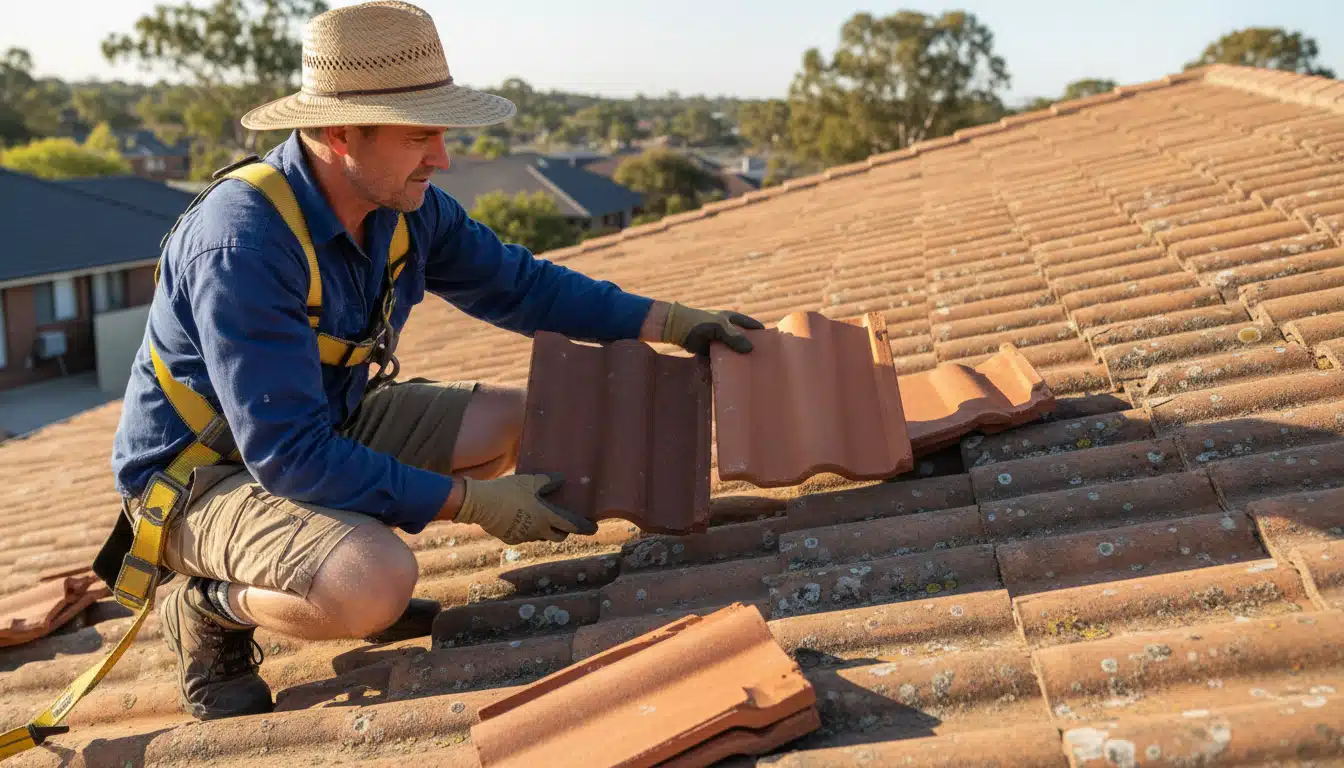
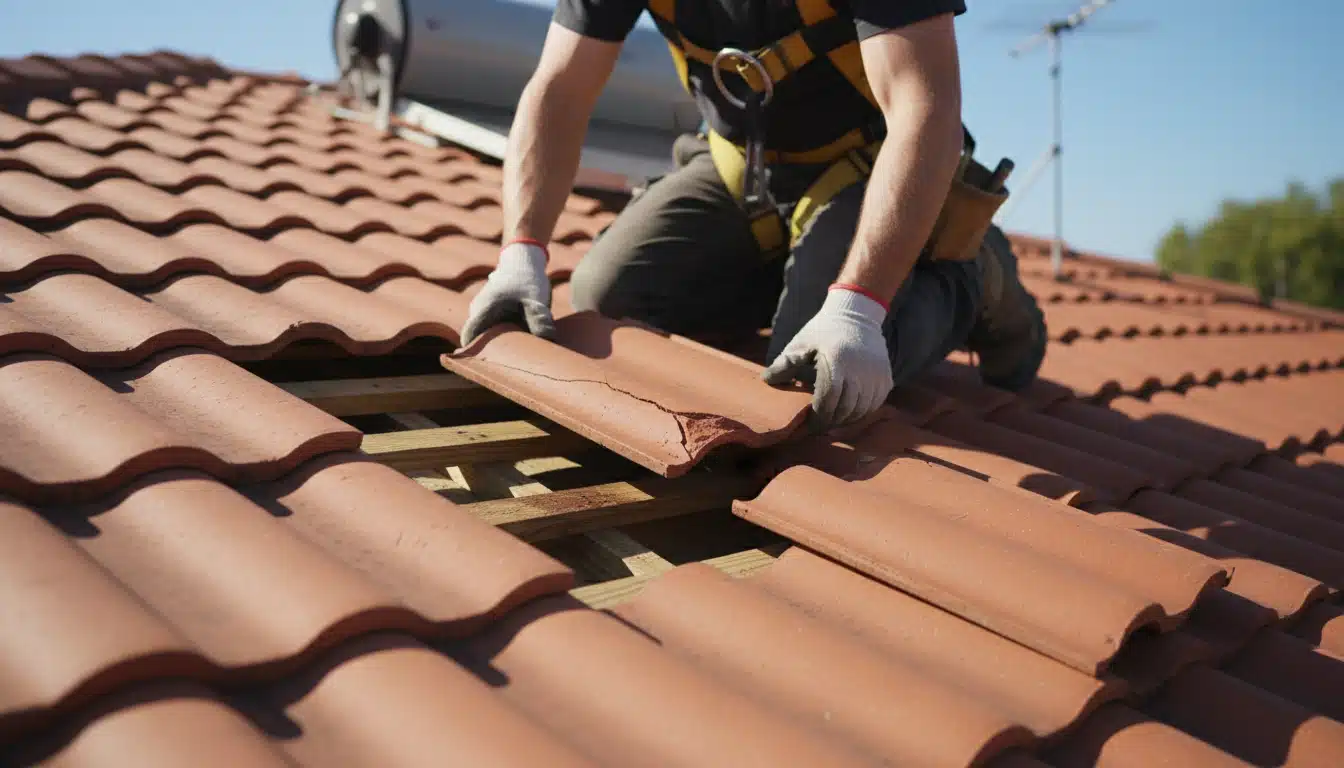
Individual tiles that sit out of alignment, show visible cracks, or have slipped from their original position create immediate water entry points. A single broken tile can allow approximately 20 litres of water into roof cavities during a moderate Perth storm. Across multiple damaged tiles, the cumulative water entry becomes substantial. Professional tile roof repairs address these failures before structural water damage occurs.
Perth’s temperature extremes create expansion and contraction cycles that stress all roof fasteners and tile bedding over time. Properties built before 1990 often used fastening methods that don’t accommodate this movement, leading to progressive tile slippage that is visible from ground level long before interior damage appears.
Valley Iron and Flashing Deterioration
Valley irons channel water from converging roof planes toward gutters. When these corrode or separate at joins, water escapes sideways into the roof structure. Look for rust staining on tiles adjacent to valleys or visible gaps in valley iron sections – both indicate urgent problems requiring assessment.
Flashing around chimneys, vents, and wall junctions prevents water entry at roof penetrations. When flashing pulls away from vertical surfaces, water finds pathways into wall cavities and roof structures. Check these junctions with binoculars during dry weather – any visible separation warrants immediate professional attention.
Gutter and Downpipe Warning Signs
Gutter systems reveal roof condition through several ground-level indicators that homeowners frequently overlook. What appears to be a gutter problem often has its cause in roof-level deterioration.
Overflow Indicators
Gutters overflowing during anything less than heavy downpours indicate blockage from roof debris. This debris doesn’t accumulate randomly – it signals coating deterioration releasing granules, biological growth shedding material, or tile deterioration creating fragments. Each of these sources points back to roof-level problems requiring investigation.
Overflow itself causes secondary damage as water cascades down exterior walls, saturates timber fascias, and pools around foundations. Addressing the roof cause resolves the gutter symptom.
Structural Gutter Issues
Gutters that visibly sag between mounting points carry excessive weight from either blockage or fastener failure. This sagging prevents proper drainage slope, creating standing water that promotes mosquito breeding and accelerates gutter corrosion from the inside.
Orange or brown rust staining on fascia boards below gutters indicates water escaping from compromised gutter systems or gutter corrosion itself. Dark streaks or biological growth on downpipe exteriors indicate leaking joins or corrosion holes that direct water toward foundations.
Comprehensive gutter and downpipe services address these drainage issues. However, their presence indicates roof-level problems that also require investigation. Permacoat, WA’s longest-serving roof restoration company with 50+ years of experience across Perth, includes complete gutter assessment in its restoration process – because roof and drainage systems function as integrated weather protection. Failure in one component compromises the entire system.
Interior Ceiling Evidence Visible From Inside
While exterior ground-level inspection covers the most accessible warning signs, interior ceiling evidence provides an additional layer of early detection without requiring roof access.
Early Warning Signs
Yellow or brown stains on ceilings confirm that water has penetrated the roof structure. The stain location rarely sits directly below the roof entry point – water travels along beams and rafters before dripping, sometimes metres from the actual failure point. This travel distance is why a single ceiling stain can indicate a larger area of roof compromise than it initially appears.
Ceiling paint that bubbles or peels often represents the earliest interior warning sign, appearing before obvious staining. This moisture-driven paint deterioration is easy to dismiss as an interior painting issue rather than a roof issue – but it warrants roof-level investigation before any ceiling work is done.
Advanced Deterioration
Black mould on ceilings or in ceiling corners indicates sustained moisture presence from roof leaks or condensation problems. This represents health concerns beyond property damage and requires urgent professional assessment.
Ceilings that feel spongy or show visible sagging have sustained significant water damage. Perth’s dry climate means many homeowners only discover roof leaks during winter rain events. By that point, months of minor water entry may have already occurred during brief summer storms without creating obvious interior evidence. Exterior ground-level monitoring provides earlier warning than waiting for interior damage to appear.
When Ground-Level Assessment Warrants Professional Inspection
Ground-level observation identifies when professional assessment becomes necessary. It doesn’t replace that expert evaluation – but it tells homeowners when to act.
Multiple Indicator Significance
A single warning sign might represent isolated damage. Multiple warning signs appearing simultaneously suggest systemic roof deterioration requiring comprehensive assessment rather than targeted spot repairs. When a Perth homeowner identifies fading coating, some biological growth, and minor ridge capping irregularity simultaneously, the case for professional inspection is clear – each individual sign is modest, but the combination points toward overall system decline.
Timing Triggers for Professional Assessment
Several situations make professional roof inspection a priority regardless of visible warning signs:
- Roofs approaching or exceeding 15 years since last restoration in Perth’s climate
- Pre-sale property preparation, where visible deterioration affects price negotiations
- Post-storm assessment after significant weather events in Perth’s winter months
- Any combination of the exterior warning signs described in this article
Perth’s Mediterranean climate accelerates coating deterioration compared to temperate Australian regions. The thermal cycling between summer extremes and winter saturation compresses the deterioration timeline that homeowners in milder climates might expect. Fifteen-year restoration intervals reflect Perth-specific conditions, not a universal standard.
Professional assessment provides photographic documentation of roof condition from safely accessed positions, identifying problems invisible from ground level and providing accurate scope for any required restoration or roofing services in Perth.
The Cost Difference Between Early and Late Intervention
The financial case for responding to early warning signs is straightforward. The numbers involved are not subtle.
Restoration Versus Emergency Repair Costs
Comprehensive roof restoration addressing coating deterioration and minor tile damage typically costs 60-70% less than emergency repairs after water damage has affected roof structures and interior spaces. A $4,000 restoration addressing early warning signs prevents $15,000-25,000 in comprehensive water damage repairs once cascade damage extends to ceiling systems, insulation, and electrical components.
Understanding roof repair costs in relation to full restoration economics helps Perth homeowners make informed decisions. Roof maintenance cost comparisons consistently show that proactive intervention at the first warning signs produces the best financial outcome.
Many insurance policies also exclude damage from gradual deterioration or lack of maintenance. Waiting until obvious failure occurs may mean funding repairs entirely without insurance coverage – a significant financial exposure that early intervention avoids entirely.
Real Estate Market Impact
Visible roof problems reduce property values by 5-10% in Perth’s competitive real estate market. Restoration investment typically returns 150-200% of its cost through maintained property value and stronger buyer appeal. For most Perth homeowners, the roof is part of their single largest financial asset – and roofing perth professionals consistently document that visible deterioration has a disproportionate impact on buyer perception relative to actual repair cost.
Buyers and building inspectors scrutinise roof condition closely. Addressing visible deterioration before listing prevents price negotiations that typically exceed the actual restoration cost. Documented professional restoration also enhances property valuations by demonstrating that maintenance obligations have been met.
Acting on What Ground-Level Inspection Reveals
Perth roofs communicate distress through clear ground-level warning signs long before catastrophic failure occurs. Coating deterioration, biological growth, displaced components, gutter problems, and interior ceiling evidence all provide early warning that professional assessment will prevent expensive emergency outcomes.
For professional roof repairs in Perth and complete restoration backed by Dulux Acratex accreditation, $20 million insurance coverage, and 15-20 year warranties, call (08) 9249 5955 to arrange a free, no-obligation roof inspection.