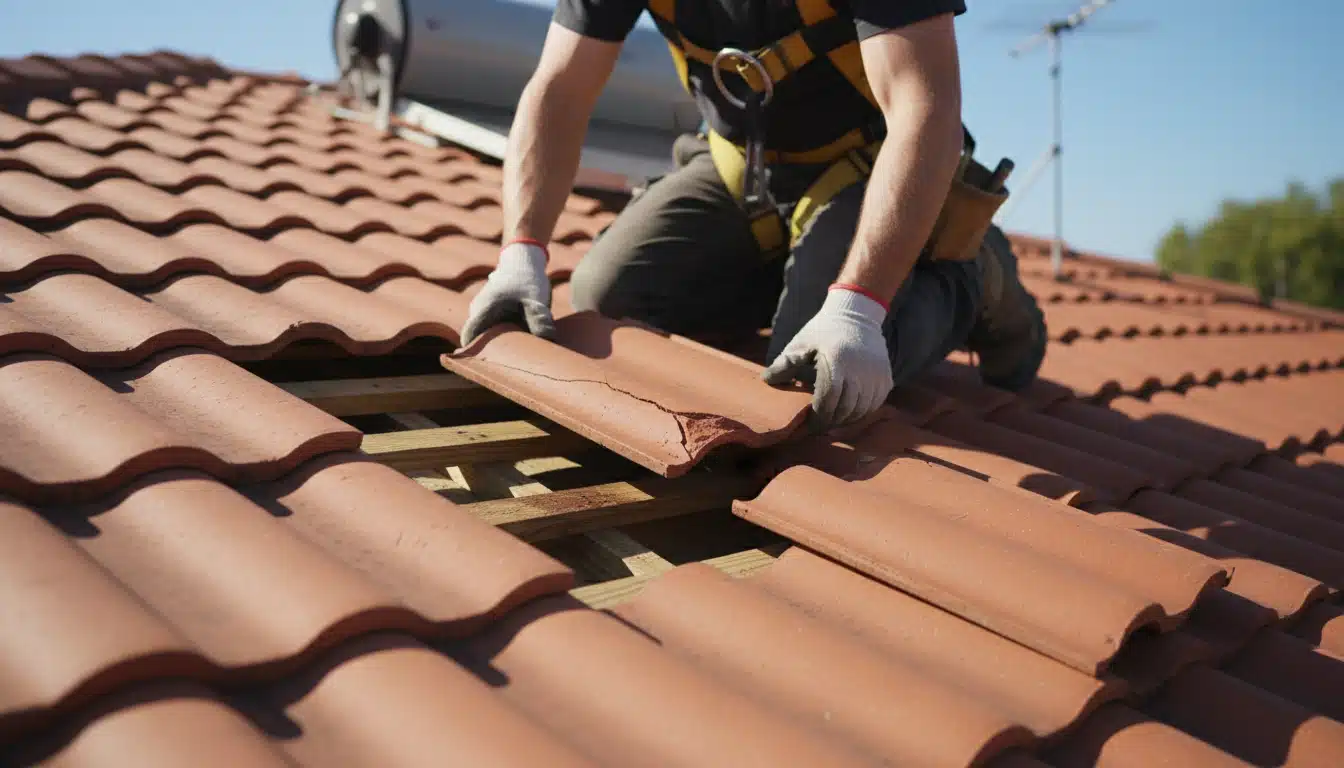
Rare tile profiles can often be sourced in Western Australia, but the process begins with identifying the exact tile rather than choosing one that merely looks similar. We compare the profile, dimensions, interlocks, nibs, material and condition before deciding whether a reclaimed or compatible replacement can be used safely.
Discontinued roof tiles create a practical problem because an otherwise serviceable roof may need only one or two replacements. The original range may have vanished from catalogues, changed name or been replaced by a subtly different design.
Colour matters, but fit comes first. A tile with the right shade can still sit too high, fail to engage with its neighbours or direct water beneath the side lap. A sound repair must restore the roof’s drainage path as well as its appearance.
Western Australian roofs also reflect decades of local building history. Extensions, storm repairs and earlier alterations can leave several tile types on one property, so identification must focus on the exact roof face and position involved.
Why Older Tile Profiles Become Difficult to Source
Manufacturers change moulds, dimensions, colours and product ranges over time. A profile that was widely installed in one building period may no longer be produced, while a later tile with a familiar name may have different laps or fixing details.
Demolition and re-roofing projects return some older stock to the salvage market, but availability is uneven. A common profile may be plentiful one month and difficult to find the next. Less common colours, regional batches and short-lived designs are naturally harder to match.
Age also changes what we see. Concrete tiles can lose surface colour or coating, while terracotta develops its own pattern of weathering. Lichen, dirt, salt exposure and previous coatings can make identical profiles look unrelated when viewed from the ground. Keep Rare tile profiles in that same decision. Keep Discontinued roof tiles in that same decision.
When a roof has broader surface wear, cracked tiles or failing ridge details, sourcing a single replacement may form part of a wider roof tile restoration assessment. That helps separate an isolated breakage from a condition affecting the surrounding roof. Keep Rare tile profiles in that same decision.
Why a Near Match Is Not Enough
Interlocking tiles are designed as a system. Their side laps, head laps and water channels work together to move rain towards the gutter. A replacement that interrupts those relationships can create an entry point even if its exposed shape appears convincing. Keep Rare tile profiles in that same decision.
Thickness is one common problem. A tile that is too thick may lift the tiles beside it, while a thinner one may sit low. Either condition can change how water runs across the roof and how securely the surrounding tiles remain seated.
Length, width and curve are also only part of the comparison. We look at the nose, underside ribs, nib position, fixing point and the geometry of both sides. Small differences can stop the tile from sitting flat or engaging correctly. That sits with tile restoration.
A loose, cracked or poorly seated replacement can shift under wind or foot traffic. If water entry has already occurred, roof repairs may also need to address nearby tiles, flashing or underlay rather than treating the visible break as the whole fault.
How We Identify Rare Tile Profiles
Identification starts with safe access and a close inspection of the affected area. The roof pitch, tile material, bond pattern and neighbouring pieces provide context before any tile is lifted.
Many tiles carry a maker’s mark, mould number or other underside detail. These marks can narrow the search, but they should be checked against the physical profile because manufacturers sometimes used related markings across more than one product or production period.
Clear photographs are useful when they show the front edge, top nibs, underside, side channels and the tile seated among its neighbours. A single overhead image rarely captures enough detail for confident matching.
Measurements should include overall length and width as well as cover width, thickness, curve height, lap depth and nib location. A few millimetres can decide whether an interlocking tile works. For practical tile repair work, the final check is how the candidate sits on the actual roof.
Where Discontinued Roof Tiles May Be Found
Reclaimed roofing suppliers and salvage yards are often the first source for discontinued profiles. Their stock may come from renovations, demolitions or complete roof replacements. Availability can depend on what has recently been recovered rather than a fixed catalogue. Permacoat treats that as part of the same roof, not a separate product.
Roofing networks can uncover stock that is not publicly advertised. Small quantities may remain with contractors, specialist suppliers or property owners who kept spares after previous work. Accurate photographs and dimensions make those enquiries much more useful.
It is also worth checking the property itself. Spare tiles are sometimes stored in a garage, shed or beneath the house. They may offer the closest colour and age match, but each one still needs inspection for cracks, chips, heavy wear and the correct profile.
Before handling or comparing older tiles, accumulated dirt may obscure mould marks and surface details. Where the wider roof condition calls for it, controlled roof cleaning can also reveal cracked, displaced or badly weathered areas that were difficult to see beforehand.
Checking a Reclaimed Tile Before It Is Used
A reclaimed tile must be more than visually similar. We check for hairline cracks, damaged corners, worn interlocks, crumbling edges and previous fixing damage. A tile can look acceptable on its face while the underside is too compromised for reliable use. Permacoat treats that as part of the same roof, not a separate product.
The candidate should be dry when assessed. Moisture can darken colour and conceal fine cracks, while dirt can hide chips around the water channels. Tapping or flexing a brittle tile is not a substitute for a careful visual and fit inspection.
The surrounding area matters too. If neighbouring tiles break during normal lifting, or if multiple laps are already damaged, the problem may be broader than one missing piece. The repair plan should account for the condition of the section, not just the easiest tile to remove.
Across more than 30,000 roofs, Permacoat has worked with the varied tile materials, profiles and ageing conditions found across Perth properties. That local experience helps us judge when an isolated replacement is sensible and when repeated breakages point to a wider roofing decision.
Matching Colour Without Compromising Fit
Once the profile and condition are confirmed, colour becomes the next consideration. A reclaimed tile from a roof of similar age may blend more naturally than a new one, but weathering is never perfectly uniform.
Orientation changes appearance. North and west facing roof planes can age differently from sheltered sections, and a tile viewed wet may appear darker than it does in ordinary dry conditions. We compare replacements in normal daylight where possible.
Previous treatments can make matching more complicated. A coated roof may have faded, chalked or accumulated grime, so an untouched reclaimed tile may contrast even when the base colour is close. Compatible roof coatings may be relevant when the existing finish is part of a broader restoration scope.
Colour should never justify forcing an incompatible tile into place. A visible but correctly fitted replacement is safer than a close shade that lifts adjacent tiles or breaks the intended water channels.
What Happens When the Exact Tile Cannot Be Found
If the exact profile is unavailable, the next step depends on the number and location of damaged tiles. One option is to move a sound matching tile from a less prominent position to the critical area, then deal with the donor position using a carefully assessed alternative.
That approach is not simply a cosmetic swap. Both positions must remain watertight, stable and properly interlocked. Moving a problem from the front roof face to the rear is not a successful repair.
Where several tiles are affected, a defined section may sometimes be replaced with a compatible profile. The transition between profiles needs particular care because mixed dimensions can disrupt alignment, support and drainage. Randomly scattering near matches through a roof face is not a sound substitute.
If visual consistency becomes part of broader remedial work, roof painting may help create an even finish after the substrate, repairs and compatibility have been properly assessed. Paint cannot correct a tile that does not fit.
A larger replacement area can be more practical when tiles are brittle throughout, salvage supply is unreliable or previous patching has already introduced several incompatible pieces. The decision should compare future repairability with the disruption of broader work.
Material and Finish Affect the Sourcing Decision
Concrete and terracotta tiles should not be treated as interchangeable. They differ in composition, surface behaviour, shape and ageing characteristics. The identification process must establish the material as well as the nominal profile.
Concrete tiles may show fading or loss of an older surface finish. Terracotta colour is integral to the fired material, although dirt, salts and biological growth can still change its appearance. These differences influence how a reclaimed replacement blends and how carefully it should be handled.
When a wider restoration is being considered, available roof colours can help property owners assess a coherent finish. The underlying tiles still need to be sound and compatible before colour choices become relevant.
Brittleness also varies across a roof. Tiles exposed to repeated foot traffic, poorly positioned services or earlier repairs may be more vulnerable than those elsewhere. Safe access planning should minimise unnecessary movement across older stock.
When Broader Roof Work Makes More Sense
A rare profile does not automatically mean the entire roof needs replacement. If the damage is isolated and sound matching stock can be found, a targeted repair may remain the most proportionate response.
Broader work becomes more relevant when breakages are widespread, every inspection disturbs more brittle tiles, or compatible replacements cannot be sourced with reasonable confidence. Persistent leaks from several details can also indicate that tile supply is only one part of the problem.
In those circumstances, re-roofing can provide a consistent roof covering and remove dependence on dwindling salvage stock. It should be considered against the condition of the full roof, not triggered by one difficult tile in isolation.
A useful assessment distinguishes immediate water-entry risks from longer-term maintenance concerns. It should explain which tiles are damaged, whether matching stock is available, how the surrounding roof is performing and what each repair option would involve.
Making the Final Tile Decision
The right replacement is the tile that restores fit, support and water shedding without creating a new weakness. Identification evidence, dimensions and an in-place check are more reliable than colour or a trade name alone.
We also consider the likely availability of future spares. If a suitable batch is found, retaining a small number of sound matching tiles can make later storm or maintenance damage easier to address. They should be stored securely where they will not crack or become mixed with another profile.
Can We Source Discontinued Roof Tiles for a Single Break?
Sometimes, if the profile still turns up in reclaimed stock or on the property itself. We identify rare tile profiles from the actual tile, not a catalogue name, then judge whether a sound match can sit in the water channel. If discontinued roof tiles cannot be found without forcing a near miss, we talk through moving a matching piece from a quieter roof face or a broader covering decision.
What Do We Check Before Using a Reclaimed Tile?
Fit first: length, cover width, nibs, interlocks and underside condition. Colour comes after that. A pretty shade that lifts the neighbouring course is not a repair. Where the wider roof is worn, tile repairs sit inside a restoration or cleaning assessment rather than a one-piece guess.
When Is Re-Roofing the Cleaner Option?
When every lift cracks another brittle neighbour, salvage supply is unreliable, or mixed patches already interrupt the laps. Re-roofing is a whole-covering choice, not a reaction to one missing tile. We set that against the roof as it stands, then you can contact us if you want that comparison on your property.
Frequently Asked Questions
Can We Source Discontinued Roof Tiles for a Single Break?
Sometimes, if the profile still turns up in reclaimed stock or on the property itself. We identify rare tile profiles from the actual tile, not a catalogue name, then judge whether a sound match can sit in the water channel. If discontinued roof tiles cannot be found without forcing a near miss, we talk through moving a matching piece from a quieter roof face or a broader covering decision.
What Do We Check Before Using a Reclaimed Tile?
Fit first: length, cover width, nibs, interlocks and underside condition. Colour comes after that. A pretty shade that lifts the neighbouring course is not a repair. Where the wider roof is worn, tile repairs sit inside a restoration or cleaning assessment rather than a one-piece guess.
When Is Re-Roofing the Cleaner Option?
When every lift cracks another brittle neighbour, salvage supply is unreliable, or mixed patches already interrupt the laps. Re-roofing is a whole-covering choice, not a reaction to one missing tile. We set that against the roof as it stands, then you can contact us if you want that comparison on your property.
When you have a broken tile, an unidentified profile or repeated trouble sourcing discontinued stock, contact us so we can assess the roof, identify the practical options and help you choose between a targeted replacement and broader roof work.