Roof coating failure rarely announces itself with warning signs. One season the surface looks sound, the next it’s bubbling, cracking, or peeling away in sheets. For Perth homeowners who’ve invested thousands in roof restoration, watching protective coatings deteriorate prematurely represents both financial loss and renewed exposure to weather damage.
The cause is almost never the topcoat. When roof coating peeling occurs, the failure typically traces back to what happened before the visible colour coat touched the roof surface. Anti-peel roof primer technology creates molecular bonds that transform how coating systems adhere to tiles, metal, and concrete – bonds strong enough to outlast Perth’s UV exposure, thermal cycling, and coastal salt spray.
Why Coating Peeling Is Almost Always a Primer Problem
The Three Primary Failure Mechanisms
Roof coatings must chemically bond to substrates while remaining flexible enough to accommodate thermal expansion and contraction. Perth roofs expand and contract daily as temperatures swing from cool mornings to 60°C+ surface temperatures by afternoon. Metal roofing can move several millimetres across a 10-metre span during these cycles.
Without proper primer-binder technology, three failure mechanisms create predictable coating peeling. Surface contamination – oils, salts, dust, and degraded previous coatings – creates barriers preventing molecular adhesion. Substrate porosity variations mean some areas absorb coating while others repel it, leading to inconsistent bond strength. Thermal stress then concentrates at these weak adhesion points, where differential expansion rates cause coatings to lift, crack, and eventually peel.
Why Topcoat Quality Alone Cannot Prevent Peeling
Coating failures are commonly attributed to topcoat quality when the actual cause is primer inadequacy. A premium topcoat bonded to a compromised primer foundation still fails – the failure plane is simply located one layer deeper than most homeowners realise.
The primer-binder layer is the structural foundation. Without it performing correctly, topcoat quality becomes irrelevant to long-term performance.
How Modern Primer-Binder Chemistry Works
Acrylic Polymer Technology and Molecular Bonding
Anti-peel roof primer formulations use acrylic polymer chains engineered to bond with both the roof substrate and the topcoat layers. Long-chain molecules penetrate surface irregularities at the microscopic level, creating mechanical interlocking alongside chemical adhesion. As the primer cures, these polymers cross-link to form a flexible yet tenacious layer that moves with the substrate rather than separating from it under thermal stress.
This cross-linking chemistry is what separates professional-grade primers from budget alternatives. The cured primer layer must accommodate the substrate’s movement while maintaining its bonds to both the surface below and the coating layers above – a demanding requirement that elastic limits and cross-link density must be specifically engineered to meet.
Substrate-Specific Bonding Agents
Bonding agents within the primer formulation react with mineral surfaces in concrete and terracotta tiles, creating ionic bonds resistant to moisture infiltration. For metal roofing, corrosion inhibitors prevent oxidation at the coating-metal interface – the primary failure point for aged Colorbond and galvanised iron where moisture eventually finds pathways to the metal surface.
The flexibility factor separates professional-grade primers from budget alternatives. Elastomeric additives allow the cured primer layer to stretch up to 300% without losing adhesion, accommodating the thermal movement that would crack rigid coatings. This flexibility extends through the entire coating system when each layer bonds properly to the one beneath it.
Why Generic Primers Fail
Generic primers claiming suitability for all surfaces represent a fundamental compromise. Terracotta, concrete, and metal roofing materials present distinct surface chemistry. Terracotta features fired clay surfaces with high mineral content requiring bonding agents that react with silicates and aluminium oxides. Concrete and cement tiles present high porosity and alkaline surface chemistry requiring deep-penetrating, alkali-resistant formulations. Metal roofing demands primers addressing both thermal expansion and corrosion prevention simultaneously.
A primer designed for one substrate type cannot optimally address another. The consequence shows up as roof coating peeling that begins at the weakest point – wherever the primer-substrate match was least effective.
Surface Preparation: Still Critical With Advanced Primers
Advanced primer-binder technology cannot overcome inadequate surface preparation. Contaminants blocking molecular contact between primer and substrate guarantee eventual coating failure regardless of product quality.
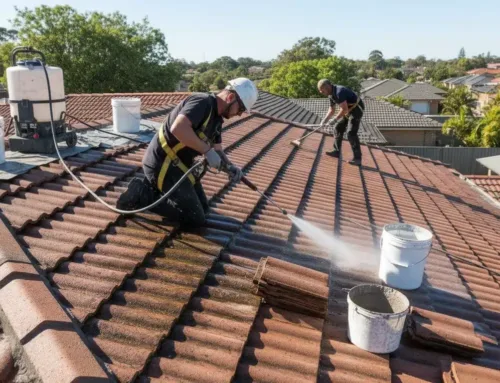
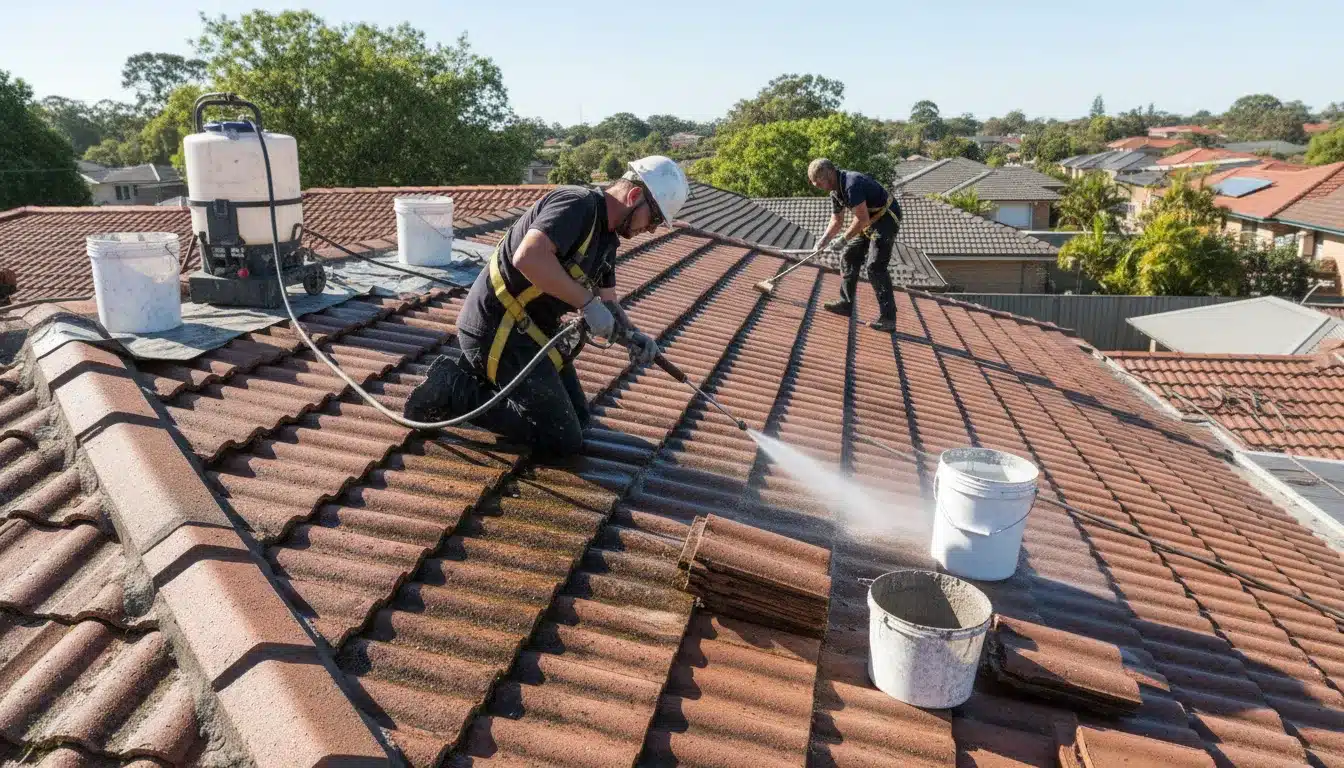
High-pressure roof cleaning removes accumulated dirt, organic growth, and loose material, but technique matters as much as equipment. Water pressure exceeding 3,000 PSI can damage tile surfaces, creating rough textures that complicate coating adhesion. Insufficient pressure leaves contaminant films that prevent primer penetration.
Chemical pre-treatment addresses issues mechanical cleaning cannot. Alkaline cleaners neutralise acidic pollutants and break down organic matter embedded in porous tiles. For roofs with previous coating failures, specialised strippers remove degraded acrylic layers that would otherwise separate from the substrate, taking new coatings with them.
The drying period between cleaning and primer application is equally critical. Tiles can retain water for 48-72 hours after cleaning, particularly during Perth’s cooler months. Applying primer-binder coats to insufficiently dried surfaces creates moisture pockets that expand when heated, pushing coatings away from the substrate from their first summer of service.
The Three-Coat System Advantage
Single-coat roof treatments represent false economy. The absence of proper primer-binder foundation and protective topcoat layers reduces service life by 60-70% compared to professionally engineered three-coat systems.
How Each Layer Serves a Distinct Purpose
The primer-sealer coat penetrates and bonds to the prepared substrate, creating uniform surface properties regardless of material variations. This foundation coat also seals porosity, preventing subsequent layers from being absorbed unevenly – a common cause of colour inconsistency and premature wear.
The first colour coat provides primary UV protection and weather resistance while bonding to the primed surface. Applied to properly primed substrates, this layer achieves adhesion strength impossible on bare materials. The chemical compatibility between the primer and colour coats creates molecular bonding rather than simple mechanical adhesion.
The second colour coat delivers depth of colour and redundant protection. If minor surface damage penetrates the topcoat, the identical layer beneath prevents moisture reaching the primer layer and substrate. This redundancy extends coating life significantly – particularly on roofs with overhanging trees or areas subject to foot traffic during maintenance.
Permacoat, WA’s longest-serving roof restoration company with 50+ years of experience and 30,000+ Perth roofs restored, applies this three-coat Dulux Acratex process because each layer’s performance depends on the integrity of the layer beneath it. The system works as an integrated whole – or it underperforms as individual components.
How Thermal Cycling Stresses Adhesion in Perth
Metal Roofing: The Most Demanding Thermal Environment
Perth’s climate subjects roof coatings to extreme thermal cycling. Summer surface temperatures exceeding 60°C drop to 15-20°C overnight, creating expansion-contraction cycles that test coating adhesion every day for months. Metal roofing expands roughly twice as much as the coating protecting it, creating shear stress at the coating-substrate interface. Without flexible primer-binder technology designed for this differential movement, coatings crack at stress concentration points – typically valleys, ridges, and sheet overlaps.
For Perth properties where metal roofing condition has deteriorated beyond what coating can address, re roofing in Perth may be a more cost-effective path than repeated restoration attempts with inadequate primer foundation.
Tile Roofs and Localised Micro-Movement
Tile roofs experience localised thermal cycling as individual tiles heat and cool at different rates depending on orientation and shading. This creates micro-movements across the roof surface. Rigid coatings without flexible primer foundations develop hairline cracks that propagate with each thermal cycle until sections delaminate.
The primer-binder layer functions as a stress-absorbing interface. Its elastomeric properties allow it to stretch and compress with substrate movement while maintaining adhesion to both the substrate below and colour coats above. This stress distribution prevents the concentration of forces that initiate coating failure.
Coastal Salt and Adhesion Pressure
Coastal properties face additional mechanisms. Salt-laden air deposits hygroscopic crystals on roof surfaces – crystals that absorb atmospheric moisture and expand, creating pressure beneath coatings at the substrate interface. Anti-peel roof primer formulations include salt-resistant polymers that maintain adhesion despite this crystal growth. Properties throughout Perth’s western suburbs benefit from primer systems specifically rated for salt exposure.
UV Degradation and Primer Protection
Perth receives among the highest UV exposure levels globally. UV radiation doesn’t just fade colour coats – it degrades polymer chains at the molecular level, attacking the coating-substrate bond over time.
Premium primer-binder formulations include UV stabilisers that absorb damaging radiation before it reaches the substrate bond. While topcoat colour layers provide primary UV protection, primer UV stabilisation ensures that if topcoat degradation occurs, the adhesion layer maintains integrity. These stabilisers provide sufficient concentration for 15-20 year protection – matching the warranty periods that properly applied Dulux Acratex roof coating systems deliver.
The Financial Case for Proper Primer-Binder Systems
The 20-Year Cost Comparison
The economic argument for proper anti-peel roof primer systems becomes clear when comparing lifecycle costs. A budget coating system without proper primer-binder might cost $4,500 for a standard Perth home versus $6,500 for a full three-coat Dulux Acratex system. The budget system failing after 5-7 years requires complete recoating – typically 15-20% higher due to inflation.
Over 20 years: budget systems require recoating twice, totalling approximately $15,700. The premium system applied once costs $6,500 with no recoating required – a saving of over $9,000 while avoiding the disruption and property access of two additional roof projects.
Hidden Costs From Coating Failure
Failed coatings allow accelerated roof deterioration during the failure period. UV damage to exposed tiles, moisture infiltration causing leaks, and thermal stress cracking unprotected materials all create secondary damage. Roof repairs in Perth addressing damage from failed coatings typically cost $2,000-$5,000 before recoating can even begin – costs entirely avoidable with proper initial preparation and primer selection.
These consequential costs fall on the homeowner when warranty exclusions apply. Budget operators offering short or limited warranties are signalling awareness that their primer foundation cannot support long-term performance claims.
Conclusion
Roof coating peeling is a primer problem. Anti-peel roof primer technology prevents the three failure mechanisms – contamination barriers, porosity variation, and thermal stress concentration – that cause coating systems to delaminate before their intended service life.
Perth’s extreme climate makes this technology essential rather than optional. UV intensity, daily thermal cycling, and coastal salt exposure place demands on coating adhesion that only purpose-engineered primer-binder chemistry can reliably meet. Budget alternatives that eliminate or compromise this foundation layer save 20-30% initially but typically fail within five to seven years, creating recoating and repair costs that eliminate any initial saving.
For expert roof restoration in Perth built on proper primer-binder technology and backed by 50+ years of experience, call (08) 9249 5955 to book your free roof inspection.